

The Growing and Unequal Burden of Gastrointestinal Cancers
Posted in Announcements
Marion Hartley, PhD.
The American Cancer Society recently published cancer statistics (Siegel RL, Kratzer TB, Wagle NS, Sung H, Jemal A. Cancer statistics, 2026. CA Cancer J Clin. 2026;e70043. doi:10.3322/caac.70043), indicating that GI cancers maintain their status as the leading contributors to cancer incidence and mortality in the United States. As a group, GI cancers rival or exceed any single primary cancer site in overall burden, and they are second only to lung cancer as a cause of cancer death despite the overall progress made in improving cancer survival. For those of us involved in GI cancer research and patient care, these statistics are disappointing: our efforts are not achieving the desired outcome.
The Early Onset Problem
There is a continued rise in cancer incidence among adults aged < 50, driven in large part by GI cancer trends. Unlike lung cancers, for example, where incidence is declining in younger populations, many early-onset GI cancers show persistent or emerging upward trends. Why might this be? There are many theories, such as the development of an unfavorable microbiome or exposure to factors encountered by these individuals while still in their mother’s womb, and research is continuing in earnest. Whatever the reason, these patterns are particularly concerning because younger patients are often diagnosed outside of routine screening protocols and at more advanced stages, contributing to higher mortality.
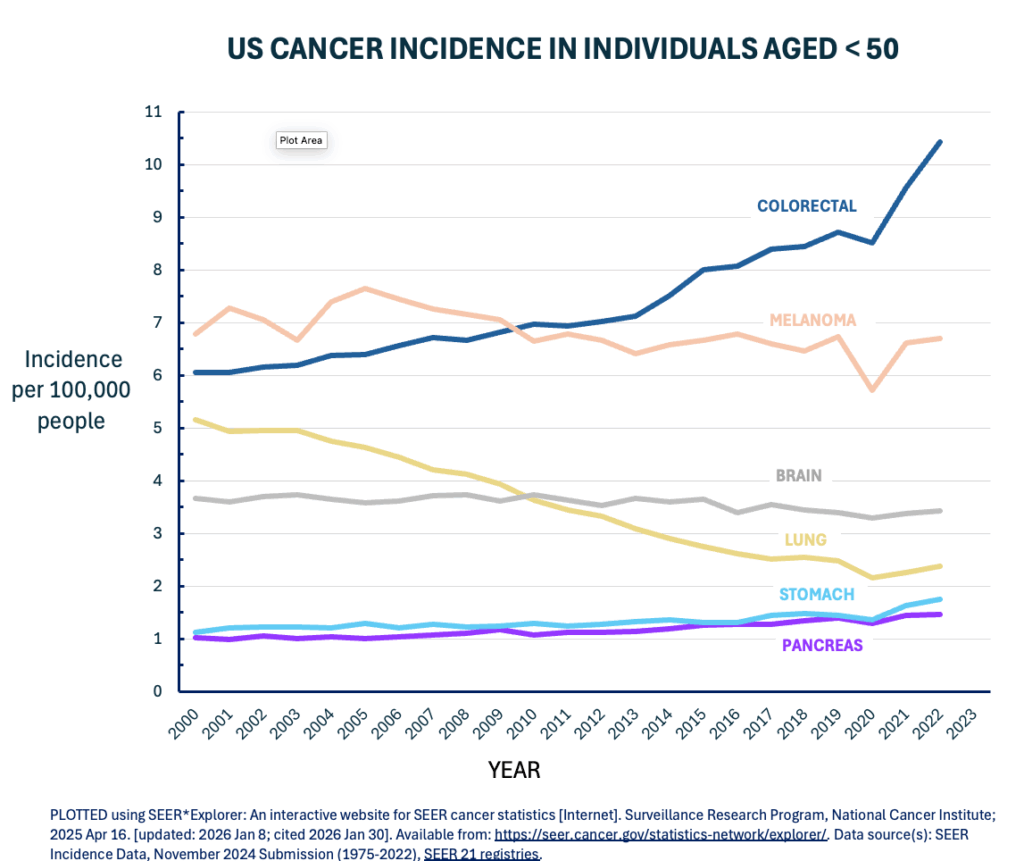
Colorectal cancer is the core of our early-onset GI cancer crisis: Colorectal cancer mortality is increasing in line with its incidence in adults < 50, and the ACS highlights this as a clear change in cancer patterns.
In older populations, colorectal cancer mortality has declined due to screening and treatment advances, but in younger adults, it is now a leading cause of cancer death. Not only is the disease generally more aggressive than in their older counterparts, but this subset of patients is too young to be eligible for, or even to consider, routine screening. If they experience any symptoms, colorectal cancer is usually not on their or their doctor’s radar. Early-onset colorectal cancer has become an essential focus for GI cancer care and research at the Ruesch Center and nationally. Efforts to raise awareness, review screening policies, and implement prevention measures are ongoing.
What about other GI cancers?
Although relatively uncommon, early-onset pancreatic cancer has a persistently rising overall burden and poor survival; even small increases in incidence among younger adults carry massive mortality impact. There is still no approved early-detection method available even to begin screening these younger individuals. When combined with the naturally aggressive and therapy-resistant nature of pancreatic cancer, it can be seen that early-onset pancreatic cancer represents a high-impact GI cancer concern.
Incidence of stomach cancer in younger adults is also on the increase. As with pancreatic cancer, absolute case numbers remain low, but these cancers are frequently diagnosed at advanced stages and are associated with poor survival.
Progress seen in other cancers has not translated equally to GI Cancers.
Taken together, the latest ACS 2026 report suggests that future reductions in overall cancer mortality will increasingly depend on addressing GI cancers, particularly those affecting young adults. While lung and breast cancer outcomes have improved through widespread screening and early detection, and well-funded research into therapies, many GI cancers remain under-screened, unrecognized, and underfunded. GI cancers are highly lethal, especially in early-onset populations, and deserve the nation’s focus and investment. At the Ruesch Center, we view this ACS publication as an urgent call to action to expand funding for GI Cancer research, especially early-onset disease. With collective resolve, we can lessen the burden of GI cancers and shape a brighter future.